
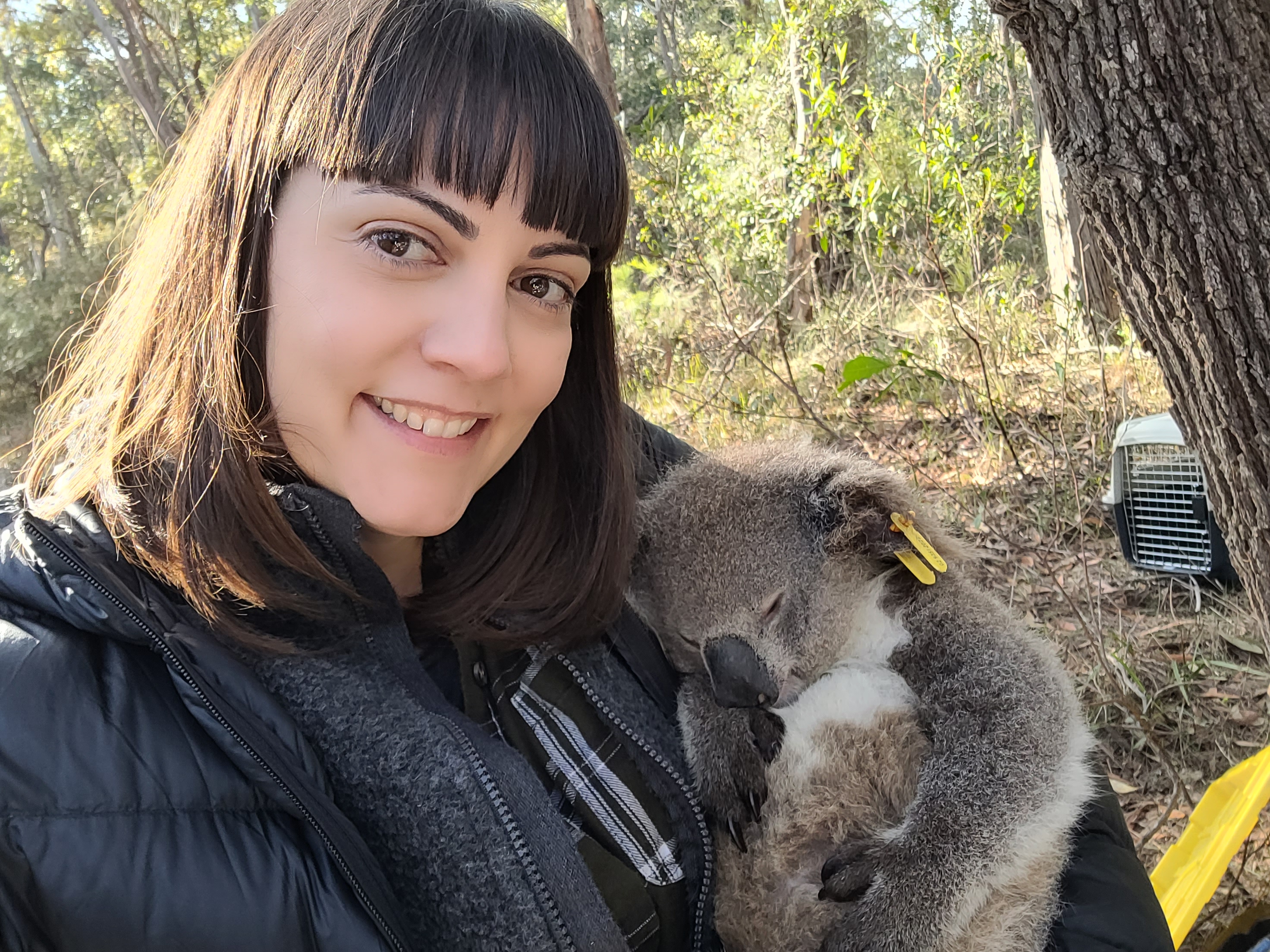
Most researchers step into leadership without being prepared for it. How do you direct a professor when you are the most junior person in the project? How do you keep a stakeholder engaged when the answer to their question is five years away? How do you hold a team together when the people in it are not able to be in the same room? Dr Valentina Mella, who leads a koala conservation project in the Liverpool Plains, New South Wales, has discovered her own answers to these questions over the past decade.
“If you think you know it all, you stop listening," is the way Dr Mella describes her approach to both research and leadership. That same quality allows her to hear what animals are trying to tell her, and also her team of ecologists, veterinarians, physiologists, students, landowners, and wildlife carers who work 700 kilometres from Dr Mella's desk at the University as Senior Lecturer in Animal Behaviour in the Faculty of Science.
Listening is what moves research forward
When Dr Mella first started working with koalas, she did not expect them to be very interesting. They sit in trees. They sleep for most of the day. To many people, there seems to be little to observe. At first, she thought the same.
“Koalas are something I stumbled onto by chance,” she says. “It’s probably not the first species you would think of when you think of observing animal behaviour, because you’d think, well, they don’t do much. At the beginning I thought, this must be really boring. But instead, I was able to discover a lot of novel things that nobody actually knew about koalas.”
The discovery came from slowing down and paying attention; not assuming and not arriving with fixed conclusions. Dr Mella learned that revelations would come from just watching and letting what was there reveal itself over time.
That same quality led to one of the biggest shifts in her research. When koala numbers in the Liverpool Plains began to fall, the working explanation was disease. However, the landowners in the area kept raising other possible explanations. They pointed to water, temperature, and climate as key factors. Instead of setting those observations aside, she listened.
She set up drinking stations across the site and found that koalas need water all year round. Before her study, the general belief was that koalas only drink when they are sick, or that they get enough moisture from the leaves they eat. She learned that the landowners had been right; the research changed direction because she paid attention to people who had spent their whole lives watching the same animals on the same land.
There's a lot of knowledge that is found in these people. Leading a project like this means, in my opinion, to listen to other people, and get knowledge from things you can't find in books.
Dr Valentina Mella
Some of those landowners are in their seventies. They have been observing koala behaviour longer than most researchers have been alive. That knowledge does not appear in any journal articles. It only becomes available to a researcher who is willing to slow down and take it seriously. Listening, in other words, is not passive. It is what moves research forward.
Work with people across difference, not around it
Dr Mella’s project brings together groups that do not always have the same priorities. She works with landowners whose access to land she depends on, mining companies that affect the habitat she studies, wildlife carers, veterinarians, students, and industry partners. Many of these groups have interests that do not always align.
"There are a lot of competing interests, which means that some people cannot sit in the same room together," she says. "So, I do a bit of both. I listen to one group, and then I explain the point of view of the other group, and then I go to the other group, and I do the same thing."
She thinks neutrality is important, and she makes sure each group feels heard and fairly represented, even when she is the only one moving between them. It is slow. It takes twice the time of a normal meeting. But it is also how she keeps everyone at the table.
The same principle applies to leading people more senior than her. She started this project as a postdoc, and her team included professors. That gap, being the most junior person in the room while also being the one responsible for the project's direction, is something many EMCRs will recognise. "It can be confronting when you have to tell professors what to do when you are a postdoc," she says. "But communication is really the key."
Her approach is not to push authority; it is to make each person feel that their contribution specifically matters. She tells people why they are involved, what they bring that nobody else can, and why that is important for the questions the project is trying to answer. She listens to feedback even when she disagrees with it.
"I'm not scared of confrontation, and I'm not scared of feedback. People might say you're doing it all wrong, and I'll still listen. I might disagree, but I listen, because people have experience and I can learn from it."
She is also honest about her own gaps. She recently attended a leadership program run by the university and came away knowing she still has things to work on. She describes herself as direct, but admits she is still learning when to soften her delivery. "I'm probably a bit too honest and blunt sometimes," she says. "There needs to be a layer of sugarcoating that I don't quite have yet."
What she has also found is that the senior people she works with have been among her most important teachers. Working alongside professors, even while leading them, has given her an education that no program could offer. "The very senior people on my team, the professors I boss around, have really shaped the way I do research. They've taught me so much about managing a project, managing people, and making sure that my research has an impact."
For EMCRs leading across a gap in rank or experience, the lesson is not about confidence. It is about communication. And about being willing to learn from the very people you are trying to lead.
Include people in the process, not just the outcome
Research in conservation takes years. For scientists, that is just how it works. For the farmers and landowners who share their land and their knowledge with a project, it is harder. They are used to seeing results. A season ends, something changes, something is produced. Telling them that an answer is five years away is not just a logistical challenge. It is a relationship risk.
"How am I going to tell this person that it's going to take five years before we have an answer for them? They won't take that," Dr Mella says.
Therefore, she changed how she structured the work. She broke the research into smaller questions, each one something a student could research and answer within a year, and brought those findings back to her partners as they came in. "I give them smaller goals that we can achieve in a shorter period of time, so that they feel content until the bigger goal is met," she says.
However, it was not only about managing timelines. It was about something deeper. People want to feel recognised for what they bring to the work, not just acknowledged for their patience. People do not stay connected to a project they feel on the outside of; they stay when they feel like they are part of what is being built.
"I try to involve them in the scientific process as well,” says Dr Mella. “Even if these people are not necessarily academics, I involve them in how the data is collected, how the data is analysed." Partners who feel included in the process, not just informed of results, are the ones who keep showing up.
For EMCRs, the practical point is to think about what it feels like to be a partner in research that is not your professional world. Plan milestones your non-academic partners can see and respond to, involve them early and often. The more people feel included, the more invested they stay.
Learning never ends
Research leadership is not something most EMCRs feel ready for when they first step into it, and the research is rarely the hardest part. What takes practice is everything around it, managing people who do not agree, staying patient over years, keeping a project moving through uncertainty, and continuing to learn even when you are already the one in charge.
For Dr Mella, all of it comes back to the same thing she has been doing since she first sat in a field watching koalas. Paying attention to the animals, to the people who live with them, to the team around her, and to feedback she does not always want to hear.
"Learning never ends," she says. "Even professors can keep learning.”
More on leadership from our community
Author
Manual Name : Riska Avia Amanda
Manual Description : Intern, Researcher Development Unit
Manual Address :
Manual Addition Info Title :
Manual Addition Info Content :
Profile image : /content/dam/corporate/images/researcher-development-hub/emcr-community/riska_headhsot.jpg
Manual Type : profile

_self
Auto Type : contact
Auto Addition Title :
Auto Addition Content :
Auto Name : true
Auto Position : true
Auto Profile image :
Auto Phone Number : false
Auto Mobile Number : true
Auto Email Address : true
Auto Address : false
UUID :
Contributor
Manual Name : Dr Valentina Mella
Manual Description : Senior Lecturer in Animal Behaviour Faculty of Science
Manual Address :
Manual Addition Info Title :
Manual Addition Info Content :
Profile image : /content/dam/physical-environment/animals-and-wildlife/dr-valentina-mella-with-koala.-university-of-sydney.jpg
Manual Type : profile
_self
Auto Type : contact
Auto Addition Title :
Auto Addition Content :
Auto Name : true
Auto Position : true
Auto Profile image :
Auto Phone Number : false
Auto Mobile Number : true
Auto Email Address : true
Auto Address : false
UUID :